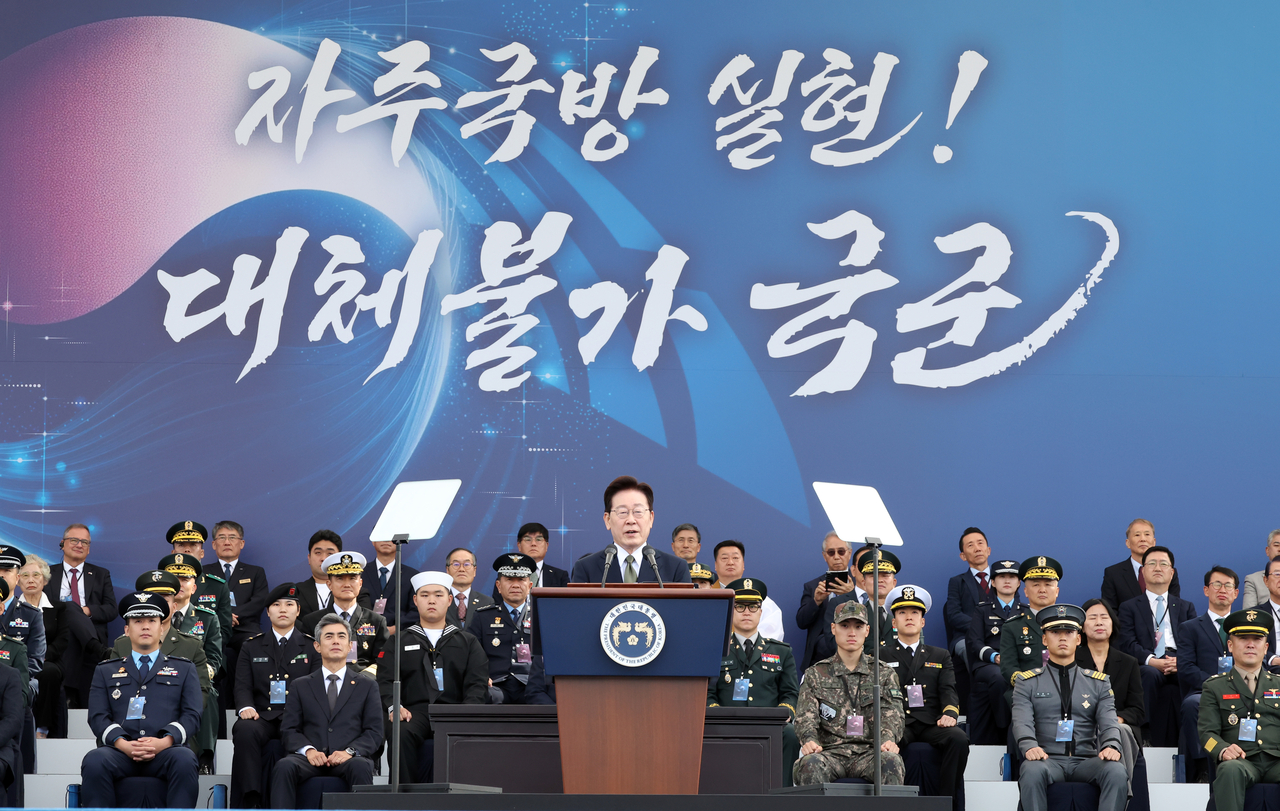
President Lee Jae Myung on Thursday urged North Korea to return to dialogue and pledged continued efforts to ease military tensions, maintaining a focus on engagement despite tension from two land mine blasts in the Demilitarized Zone last week.
Marking Armed Forces Day, Lee opened his address by expressing sympathy for the three South Korean soldiers wounded in the Sept. 21 explosions, before stressing that lasting security ultimately lies in creating “a peace in which there is no need to fight.”
“When I think of our service members who were injured in the unfortunate incident in the Demilitarized Zone not long ago, my heart still aches,” Lee said at the Armed Forces headquarters complex in Gyeryong, South Chungcheong Province.
“I wish them a speedy recovery and extend my deepest sympathies to their families.”
Lee, who visited the wounded soldiers at the Armed Forces Capital Hospital a day before delivering the speech, focused his remarks on the soldiers and their families rather than directly addressing North Korea’s responsibility for the incident.
“It reminds us once again that the ordinary lives we enjoy are made possible by the risks borne by others,” Lee said.
The remarks came a day after South and North Korea exchanged warnings over the explosions, which occurred during South Korea's operation to clear and establish a route in the southern part of the DMZ.
On Wednesday, Kim Yo-jong, the sister of leader Kim Jong-un, rejected Seoul’s assessment of the incident. Later, the South Korean military demanded an apology and “responsible measures” from Pyongyang, saying North Korean mines were responsible for the explosions.
The United Nations Command separately said its investigation had determined that an Armistice Agreement violation occurred after an active North Korean mine was found south of the Military Demarcation Line.
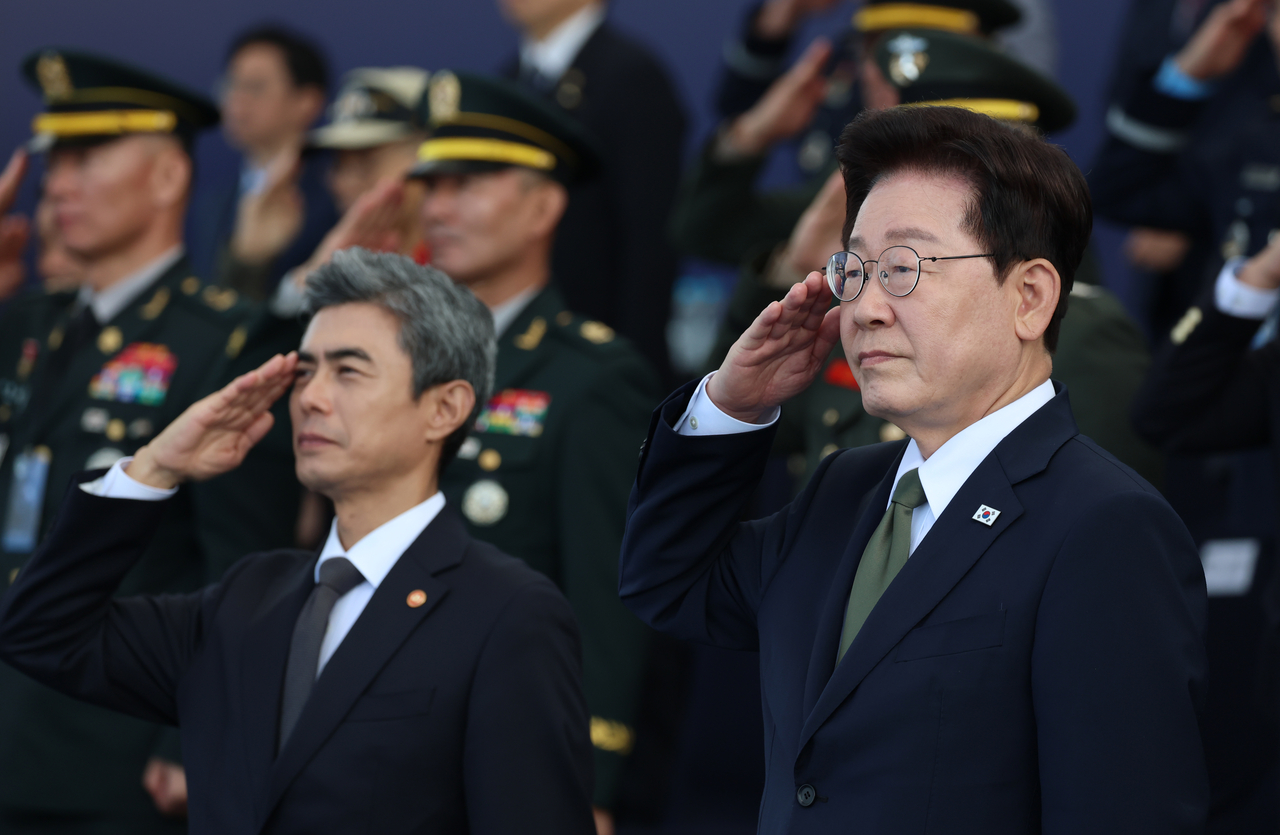
However, Lee put greater emphasis on dialogue, trust-building and tension reduction than on assigning responsibility for the blasts or condemning North Korea.
“Peace and prosperity on this land are not something others will create for us. As we have done until now, they are something we have to build ourselves,” Lee said.
“Winning a fight is important, but winning without fighting is more important. And the surest form of security is to create a peace in which there is no need to fight.”
Lee then said the two Koreas should rebuild trust.
“For the sake of peace on the Korean Peninsula, the two Koreas should find a way to ‘win together’ and build trust,” he said. “Trust is not built through words alone. It begins to take root, little by little, when words are matched by actions.”
Lee said his government would “continue to take substantive measures to reduce military tensions between the two Koreas.”
“The knots in inter-Korean relations are deeply tangled, but we will continue, patiently and step by step, to untangle them,” he said. “We hope and urge the North to now join us in restoring trust and reviving the dialogue that has been cut off.”
Lee’s calibrated message reflected the competing pressures facing his administration: preserving room for dialogue and tension reduction while leaving its response to the mine incident open until the facts are fully established.
A day earlier, Senior Secretary for Public Relations and Communications Seong Ghi-hong said the presidential office was “not taking a passive approach” and would take “necessary measures commensurate with the findings” once a full investigation had established the facts.
That restraint comes amid talk of renewed US-North Korea diplomacy, possibly at the APEC summit in Shenzhen, China, with Lee seeking to preserve Seoul’s role as a “pacemaker” for dialogue between Washington and Pyongyang.
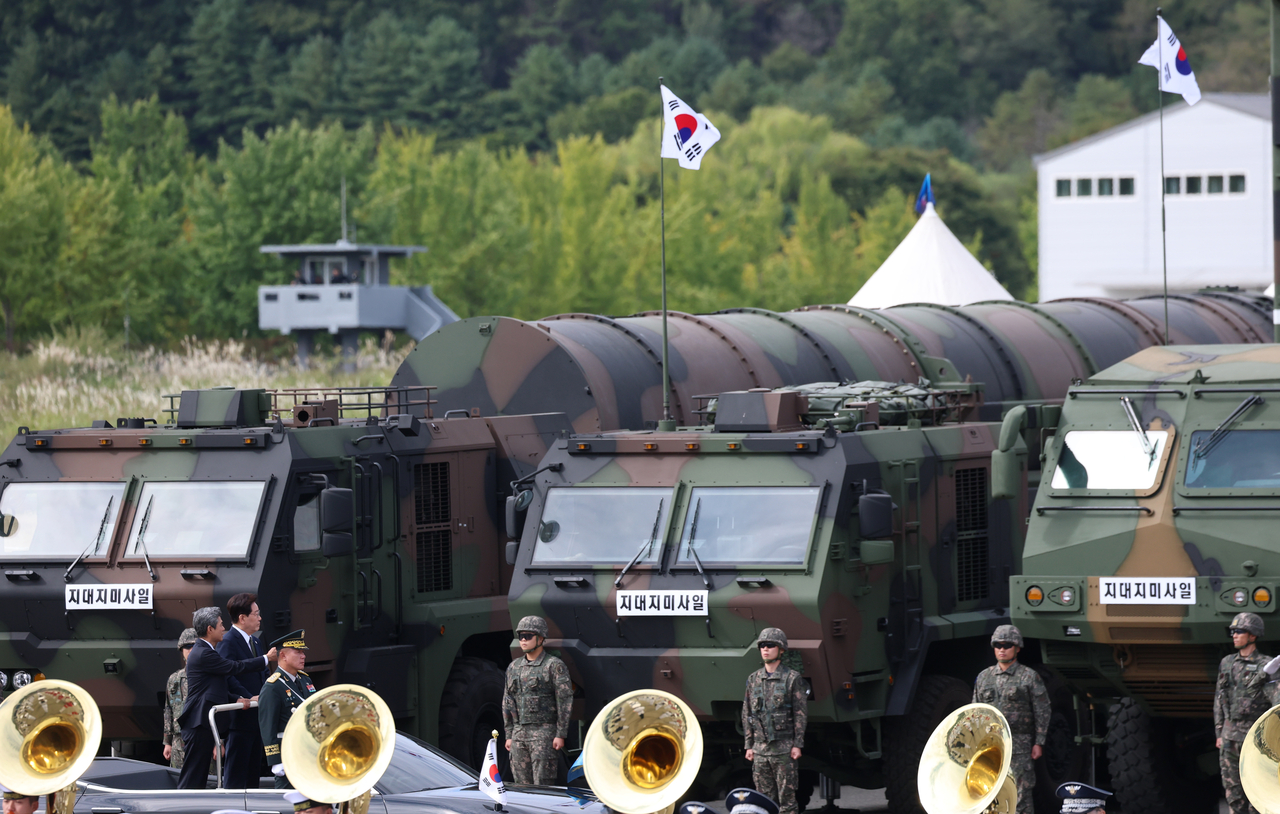
At the same time, Lee made clear that engagement would be accompanied by a push for greater military self-reliance, pairing his call for dialogue with an emphasis on strengthening South Korea’s ability to defend itself.
The Armed Forces Day ceremony showcased some 70 pieces of military equipment across 46 weapons systems and key platforms. Those weapons included the Hyunmoo-5 surface-to-surface ballistic missile, dubbed the “monster missile” for its ability to deliver a warhead of up to 8 metric tons, and the domestically developed Cheongung-II medium-range surface-to-air missile system.
As part of that broader push for greater military self-reliance, Lee underlined Seoul’s goal of “successfully building a nuclear-powered submarine using our own technology by the mid-2030s.”
Lee also reaffirmed his commitment to completing the transfer of wartime operational control from the United States within his five-year term.
“Going forward, we will complete that effort by regaining wartime operational control and finally realize, together with the people, the half-century-old dream of self-reliant defense,” Lee said.
“Self-reliant defense is sovereignty.”
dagyumji@heraldcorp.com
![[Legal updates in Korea] New insurance mandate protects firefighters on the job](https://wimg.heraldcorp.com/news/cms/2026/10/01/news-p.v1.20261001.76835f19eb424f18814ac3bb65d896a9_T1.jpg?type=h&h=800)